



Recently, I got into an interesting conversation with my brother, Big Sam. He had shared a piece of news on his Instagram story. I responded with a sarcastic emoji. I thought the news story was a concoction, something in the realm of conspiracy theory. He asked me why I felt that way. Well, for one, it had not been reported by any of the traditional news outlets. He scoffed. Many important news stories are not reported by mainstream news outlets. I conceded the point. But the news story he had shared was making an outrageous claim. Why would he believe that? But he didn’t actually believe it. He thought it was credible. Another good point. Then he struck me with a popular and convincing argument: you don’t consider it credible because you are defending your profession as a journalist. He is right. I have practiced journalism as a profession for more than a decade. That is, all my paychecks flow from journalism institutions. I am bound to journalism, in body and soul. So, when I am on the Internet, I am more likely to give credence to information from journalism institutions. But I was not defending my profession at the time. I was (foolishly) defending journalism. What is the difference?
Most people think of journalism as a profession (substantiated by Field theory) but there are many ways to define journalism. In 2004, journalism professor, Barbie Zelizer, published a book exploring and analysing these definitions and perspectives. You can think of journalism as a craft, as an institution, as a cultural practice. Others think of journalism as a sixth sense, a container, mirror, story, child, service, engagement or type of discourse. The possibilities are endless.
While definitions of journalism vary, a pattern emerges once we look closely. Journalism is thought of as something that human beings do. In other words, journalism cannot exist without human beings. In this sense, it is like medicine or engineering or law. However, unlike these other professions, journalism does not seem to have a specialized epistemology. To become a lawyer, engineer or a doctor, one ought to spend years in training. The barrier for entry into journalism is lower because it is an activity that appears easy or natural to do. Walter Lippmann, the great 20th century political theorist, pointed out in 1922 that people are happy to pay for legal, medical and engineering services; but they are reluctant to pay directly for journalistic services. Yet, the vital function of journalism in society is generally accepted as a given. For Thomas Paine, as quoted by Prof. Zelizer, journalism helps us to “see with other eyes, hear with other ears, and think with other thoughts than those we formerly used.” In June 2000, Pope John Paul II described the work of journalism as “sacred”. Why, then, does journalism seem easy to do, not generally considered worth paying for, yet its output is so highly valued? Is this because we do not really know what journalism is?
To understand what journalism is, we need to break from the pattern of assuming that its existence is bound to humanity. That is, we need to move away from what academics describe as a normative understanding. From a normative perspective, journalism ought to be good or thought of in terms of quality. From this standpoint, it is possible to have bad or low-quality journalism. But we need to move beyond manichean tendencies towards the realm of metaphysics. We need to acknowledge that journalism can exist without human beings, but human beings cannot exist without it. Journalism works through human beings but it also works through inanimate things like media. Although journalism has no volition or goal or purpose, its production and circulation is the origin of consciousness.
Moving journalism into the realm of metaphysics is not an idea from nowhere. In her 2017 book, ‘What journalism could be’, Prof. Zelizer strongly argued for incorporating ‘imagination’ into our understanding and practice of journalism. Although Prof. Zelizer continues to view journalism as a profession and strictly in normative terms, I perceive her emphasis on ‘imagination’ over logic as a challenge for future thinkers to push the limits of how we grasp the phenomenon by moving beyond traditional frameworks. It is in this spirit I make my argument: that journalism is not a profession like law, medicine or engineering but a rhetorical being.
What is a rhetorical being?
To understand the term ‘rhetorical being’, we should contrast it with ‘natural being’. This suggests the particular cosmology we employ in our thinking assumes there is a natural realm and a rhetorical realm. To do this, we should draw on centuries of Western thought about rhetoric and African communication philosophy. We know that the human being is a natural being because we engage in what Hannah Arendt would describe as the natural processes of repetition, production and consumption. Nature is what is and will always be. It is constant and precedes human existence. But what makes the human being a rhetorical being? Again, drawing on Arendt’s explication of Western philosophy, we can make the case that we become rhetorical beings by engaging in speech and action (politics). A child is born and she cries. That is a speech-action. A person realizes they are sitting in a burning building and starts to flee. That is a speech-action. A person is dancing in a club. That is a speech-action. A person discovers they are being cheated and raises their voice. That is a speech-action.
However, while it is true we can think of human beings as a rhetorical being, the human being is not categorically a rhetorical being. One way to explain this is to draw on African communication philosophy, which acknowledges the existence of a spirit world that exists alongside (not outside) material reality. The average African knows this world exists, which is why we go to churches and mosques and shrines, offer prayers and libations to unseen forces and surround ourselves with hope. We know we are not alone. Even the dead are not really dead. The ancestors are somewhere and can be called upon through speech-actions. This sense of the other is the basis of Ubuntu, the idea that a person becomes a person only through another person. It is also the same concept Jesus of Nazareth was referring to when he said ‘Have ye not read, that he which made them at the beginning made them male and female’. Although he was speaking in the context of marriage, where it is possible for two to become one, the reference to “the beginning” suggests the atomic essence of consciousness is plural. Therefore, a natural being cannot be a rhetorical being at the same time. To the extent that a person is a natural being – flesh and blood – they cannot be a rhetorical being. What, then, is the relationship between the natural and the rhetorical?
The natural being draws on rhetorical beings to make the world. The natural being is the subject and rhetorical beings are objects, tools, instruments, apparatuses for constructing worldly-reality. For example, a person quoting Shakespeare is bringing to existence a particular form of worldly-reality. A person throwing blows at a contest is creating a peculiar form of worldly-reality. In both cases, natural beings are drawing on rhetorical beings to create worldly-reality. I have used both examples so I can explain why language and culture are not categorically rhetorical beings. Language, to paraphrase Stuart Hall, is a vessel for representing thoughts, ideas and feelings; culture is the how of language. The person who quotes Shakespeare has journeyed into the rhetorical realm through what we know as memory. And, using language, they have made a representation of what they found, based on their manipulations of rhetorical beings. Culture is how they make that representation. A blow-thrower may favour fast movements or defensive postures, depending on historical, biological, geographical and other factors. So, both language and culture are closely linked to the concept of rhetorical beings, but they are not the same thing. What, then, can be described as a rhetorical being?
Before answering the question, it is more pertinent to respond to a different puzzle. Where are rhetorical beings? Here, again, we draw from African communication philosophy, where both the physical and spiritual are inseparable. Rhetorical beings are not a mystery. They are everywhere. They are in the space between your face and the screen. They are within the spaces between every cell, every atom. They are caked into the architecture of our expanding universe. This is precisely what Jesus of Nazareth had in mind when he said “The kingdom of God cometh not with observation: Neither shall they say, Lo here! or, lo there! for, behold, the kingdom of God is within you.” The kingdom – rhetorical beings, as revealed to human beings – is not a point in history. It is a state, a condition embedded in nature.
Now, we can return to the question of what can be categorically described as rhetorical beings. In other words, what exists purely in the rhetorical realm but is not natural, yet precedes human existence? Some thinkers take a legalistic approach to this question. That is, they appeal to reason. The problem is, reason, like the artefacts of language and culture, is located in the individual. Reason is not out there in the world outside of human construction. It cannot be observed as a distinct self without referring back to itself. Others take a cultural approach, appealing to shared human values. Again, like reason, culture is not something to be defined outside of the individual or group. Any attempt to champion reason or culture as rhetorical beings leads to what journalism professors Silvio Waisbord and Claudia Mellado describe as “philosophical existentialism”. This is the idea, they write, that ‘“being” is relational and unpredictable rather than predetermined”. And some others take a scientific approach, the idea that if we follow the dictates of reason and culture, we can come to know rhetorical beings. This approach does not answer the question but postpones the answer.
Our answer, as already revealed from the beginning of this ramble, is that the notion of journalism is the most productive way to describe rhetorical beings. This is because it does not reject the legal, cultural and scientific approaches. Instead, it incorporates them. But, first, we must abandon the idea of journalism as a profession. The journalist can be a professional. But journalism is not just located in the individual. It is out there in the world. It is public, a resource available to all regardless of age, gender, ethnicity or nationality. Journalism is a rhetorical being.
How do we know journalism is a rhetorical being?
It is not enough to declare journalism as a rhetorical being. We need a mechanism through which it can be identified. Without such a means, the concept remains an idea not a metaphysical reality. To do this, we must return to language. However, our language must be subject to falsifiability. We borrow the notion of falsifiability from Karl Popper. Although Popper was writing about the ranking of scientific theories, we intend to use his idea to justify our description of journalism as a rhetorical being, a metaphysical object known to all. To be acceptable in a rational sense, our description should be refutable and testable. But it must also be ontologically coherent, consistent and fixed, like a mathematical equation. To the extent our description passes these tests, one may confidently assume the existence of journalism as a rhetorical being.
The table below describes how journalism can be produced as a rhetorical being and how it circulates. We do not explain the table in this ramble because that’s a much larger project. But we can provide a quick illustration of how to read it.
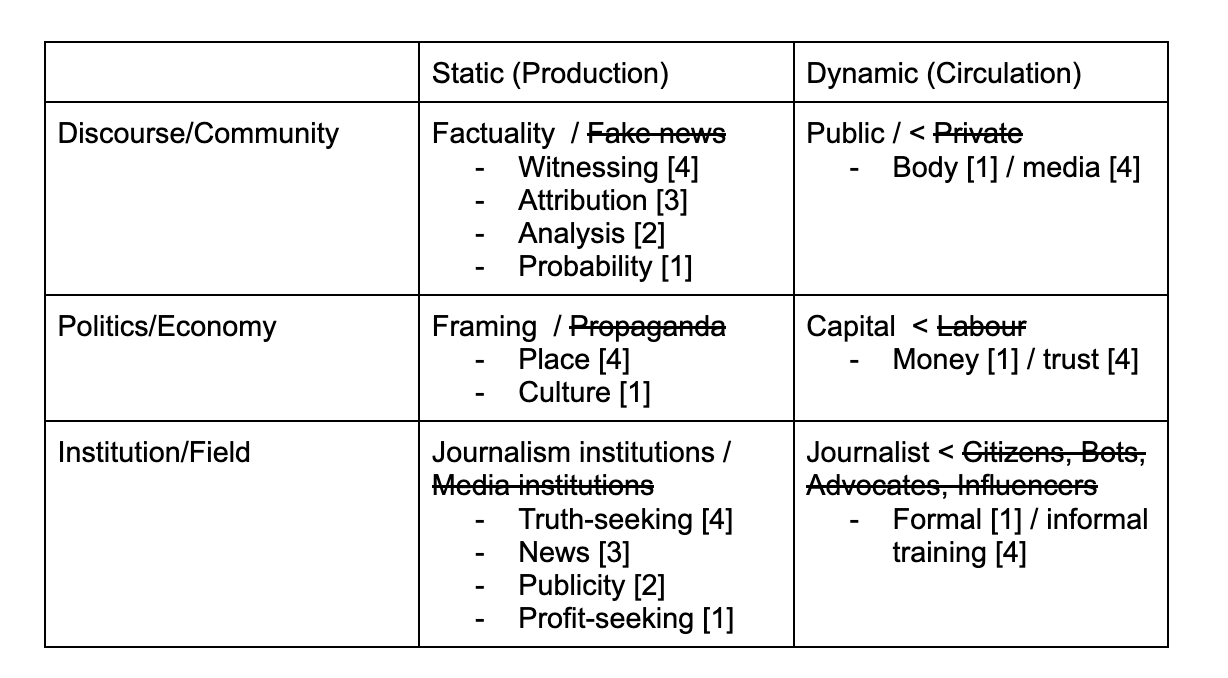
The first column establishes the scope of the description. For example, Discourse is matched with Static (Production) / Factuality. This suggests journalism comes into natural being through Discourse. We define Discourse as the exchange of thoughts, ideas and feelings. Discourse is our first contact with journalism as natural beings. Then, we differentiate journalistic Discourse from non-journalistic Discourse. Journalistic Discourse is produced through Factuality. We then proceed to define Factuality in relation to Fake News. To do this, we identify four components of Factuality and numerically weigh their relevance. When we reverse our weights, that is, when Witnessing becomes [one] and Probability becomes [four], the definition points to Fake News, which is defined as Discourse produced humorously or which is not intended to be taken seriously, such as tabloid newspapers or fictional narratives. This does not mean fiction does not contain journalistic Discourse, but our definition allows us to debate and measure the extent to which Discourse is journalistic or not.
Let us do one more. Community is matched with Dynamic (Circulation) / Public. We define Community as ‘more than one individual’. So, we can observe the circulation of journalism where at least two people are gathered. This should bring to mind the words of Jesus of Nazareth, when he claimed that “For where two or three are gathered together in my name, there am I in the midst of them.” Jesus, of course, was trying to emphasize the sacred importance of the other in the making of worldly-reality, especially as his disciples had started to squabble over individual superiority. The concept of Ubuntu also stresses the other. But, as our weighting shows, journalism circulates in greater numbers through media or inanimate channels. However, unlike the static column, there is no reversal of weights. We have crossed out ‘Private’ because it is impossible to observe and then measure the circulation of journalism outside of Community.
So, in short, we know journalism is a rhetorical being because we have a method that tells us how it can be produced and how it circulates.
Back to reality
Like my brother, Big Sam, most people continue to think about journalism as a profession. It is currently the most empirical way to think about it, especially in the context of the increasing industrialization and democratization of society. But I have argued in this ramble that thinking about journalism as a rhetorical being is a much better way to grasp the phenomenon. A rhetorical being, when thought of in singular terms, is the foundation of human consciousness. For most people, this idea is rooted in law (God, Government, Self, Community, Karma, Capitalism or some other cosmic accountant), which is then expressed in cultural (liberalism, nationalism, tribalism) or intellectual (scientism) terms. These approaches are not necessarily wrong but they fall short in their description of first causes. Thinking of journalism as a rhetorical being does not. ✚